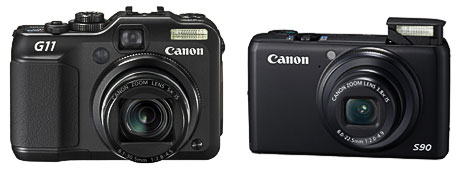
I don’t write about every camera announcement, but these two are noteworthy. While Canon announced six new compact cameras on August 19, there were two in particular that I knew my friends and I would be interested in. The PowerShot G11 is the successor to the G10, a rather large compact with professional features. The PowerShot S90 resurrects the S-series that had more manual control and capabilities that most other point-and-shoots. These announcements affect me since I’m in the market to replace my 5-year-old Canon point-and-shoot, but there’s also quite a bit of intrigue behind this particular set of upgrades.
Please note that this post is not a review, but a commentary on the announcement. The cameras will be available in September 2009.
The Megapixel Wars: Over?
For several years, Canon ratcheted up its megapixel counts like all the other camera companies: 12 megapixels in the G9, 14 megapixels in the G10. But photographers increasingly complained (and rightly so) that not only did more megapixels not guarantee better images by themselves, in some cases they hurt image quality through increased noise. And at the same time making file sizes larger, which reduced the effective capacity of memory cards, hard drives, and CPUs.
Then last year, Panasonic came out with the Lumix DMC-LX3. Many were surprised that it held the pixel count to just 10 megapixels while all other companies raced upwards. That, and the fact that it has a relatively fast lens, may be the reason it also produces images that are thought by many to be better than the G10 in low light. It also has a wider wide end than many compact cameras, which makes it more useful for indoor use. For these reasons plus its raw output capability, many photography enthusiasts embraced the LX3 and it’s been back-ordered for many months. I thought it would be my next compact camera, but I can’t get one. The specific improvements to the Canon PowerShot G11 and S90—faster lens, better low light performance, more reasonable megapixels, and a shocking drop down to 10 megapixels—resemble the strong points of the LX-3 so much that one has to ask: Did the apparent popularity of the LX-3 make it enough of a threat for Canon to have to defend against the LX3 directly? Did Canon believe that they could not continue to maintain image quality from such small sensors if the pixel count went up further?
I think there may be more to it than that, since Canon also decided to bring back the swivel screen to the G series and the raw format to the S series. Now that more people use their camera phone as their point-and-shoot, did Canon feel they had to provide (or restore) more value in the compact range so that serious photographers would have a reason to buy a camera between a JPEG-based point-and-shoot and a digital SLR?
Comparing the PowerShot G11 to the PowerShot S90
With all that context in mind, you might want to compare the G11 and S90 since they’re so curiously similar. These two cameras use the same extended dynamic range sensor and new Digic 4 processor going up to ISO 3200, and both can save in raw format. Here are a few of the important differences between them.
Reasons to get the Canon PowerShot G11 (list price USD$499) over the S90:
- Hotshoe that supports Speedlites (and hopefully wireless triggers)
- Longer telephoto range
- Slower lens (f/2.8)
- Better face detection
- Closer focusing distance (1cm)
- More ISO steps
- Shutter speed up to 1/4000
- Slightly faster frames-per-second burst rate
Reasons to get Canon PowerShot S90 (list price USD$429) over the G11:
- Smaller size is a lot more pocketable
- Faster lens (f2) for better low-light shooting
- Slightly bigger LCD screen (same number of pixels, though)
- Interesting control ring around the lens to which you can assign a function, such as ISO speed
The Canon Shell Game
With their point-and-shoots, Canon has a really annoying way of taking features away and adding them back in a later version with no apparent rhyme or reason. As the G series progressed, people noticed that the swivel screen went away. When the S80 came out, raw format support disappeared. Now both are back. The swivel screen has returned in the G11, and the S90 brings back the ability to save images in raw format.
So what’s missing? Both cameras are capable of only 640×480 30fps video, a strange underachievement in an era of at least 720p HD video on competing cameras. One imagines that video will get a boost in the next generation, but that Canon might once again take away something useful in exchange. Maybe one day Canon will put out a compact where all of the right features actually exist in the same model, but that hasn’t happened yet.
The Details
I’ve only talked about the aspects of these two new cameras that I found to be a notable departure from Canon’s usual pattern. For full details, check out the info at the Canon USA site:
Canon PowerShot G11
Canon PowerShot S90
Voting with Dollars
Which one will I choose? Good question. Canon now has two cameras which in theory should keep people from going over to the LX3. But in addition to the fact that we should wait for the reviews to roll in, the LX3 is a year old now, and with all the fall photo expos just around the corner, is Panasonic about to play their next card?…
The good news is that with the expansion of choice, it’s now harder to pick the wrong advanced compact camera.
(Update: I bought the Panasonic LX3 because the fast aperture is nearly constant throughout the zoom range, for the hot shoe, and for the 720p 16:9 video capability. And I’m pretty happy with it!)


 conrad chavez | blog